3 Sum
Find every group of three numbers in an array that adds up to zero, each group listed once.
From an array of integers nums
Example 1
Output: [[-1, -1, 2], [-1, 0, 1]]
Example 2
Output: []
Explanation: no three numbers add up to 0.
Example 3
Output: [[0, 0, 0]]
The Idea
Picture six number cards on a table: -1, 0, 1, 2, -1 and -4. You may pick any three of them, and you want the picks that add up to 0. There are 20 ways to pick three cards out of six, and three of them work: the first -1 with 0 and 1, the second -1 with 0 and 1, and both -1s with 2.
Yet Example 1 lists only two triplets. The first two picks hold the same values, -1, 0 and 1, so they count as one triplet. That raises two questions: how do we find the triplets without trying every pick of three, and how do we report each one only once? With 3,000 numbers, there are about 4.5 billion picks of three.
Sorting helps with both. Sorted, the example reads -4, -1, -1, 0, 1, 2, and the two -1s now sit side by side. Sorted order also makes it quick to find two numbers with a given sum. Start one marker, lohilohi
Now fix the first number of a triplet with a third marker, iiilohii
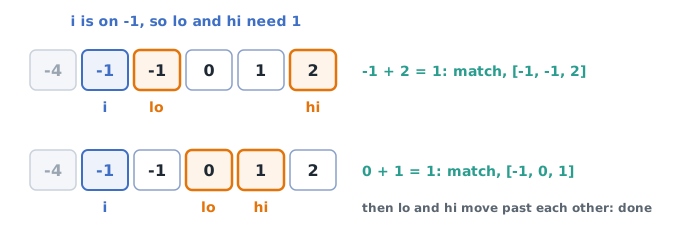
In the first row, lohilohii
So a triplet is one fixed number plus a pair, and the pair is found by walking two markers toward each other instead of trying every pair. This way of searching is called the two-pointer technique. Finding a pair with a given sum in a sorted array is the problem
Solution Approach
Turning that idea into code means settling three things: how to pick the first number, how to search for the other two, and how to report each triplet only once.
Choosing the first number
Why not simply try every triplet? That takes three loops, one inside the other, and about 4.5 billion picks for 3,000 numbers. It also finds [-1, 0, 1] twice in Example 1, so a set would be needed to drop the repeat. Fixing one number and searching for the pair replaces the two inner loops with a single pass.
After sorting, one loop moves ilohiii
That gives a way to stop early. Once the number at ii
Searching for the other two
Where do lohiloihilohilohi
Why can a small sum safely leave the number at lohihii
Reporting each triplet only once
How do we report each triplet only once, when the array has repeated numbers? Sorting put equal numbers together, so a repeat always sits right after the number it repeats. If i
After a match, lohiilohihi
Java Solution
The method threeSum
- First, sort the input array with
Arrays.sort(nums)result - A loop moves
i - Inside the loop, two checks come first. If
nums[i]breaknums[i]continuei - Then search for the other two numbers:
loi + 1hilohisumlohi - When
sumresultlo - When the loop is done, return
result
The main[-2, 0, 0, 2, 2, -2][3, 1, 2]
import java.util.ArrayList;
import java.util.Arrays;
import java.util.List;

public class ThreeSum {

    public static List<List<Integer>> threeSum(int[] nums) {
        Arrays.sort(nums);
        List<List<Integer>> result = new ArrayList<>();
        for (int i = 0; i < nums.length - 2; i++) {
            if (nums[i] > 0) {
                break;                        // smallest of the three is positive: no sum of 0
            }
            if (i > 0 && nums[i] == nums[i - 1]) {
                continue;                     // same first value: same triplets again
            }
            int lo = i + 1;
            int hi = nums.length - 1;
            while (lo < hi) {
                int sum = nums[i] + nums[lo] + nums[hi];
                if (sum < 0) {
                    lo++;                     // too small: take a bigger second value
                } else if (sum > 0) {
                    hi--;                     // too big: take a smaller third value
                } else {
                    result.add(List.of(nums[i], nums[lo], nums[hi]));
                    lo++;
                    hi--;
                    while (lo < hi && nums[lo] == nums[lo - 1]) {
                        lo++;                 // skip repeats of the second value
                    }
                }
            }
        }
        return result;
    }

    public static void main(String[] args) {
        System.out.println(threeSum(new int[] {-1, 0, 1, 2, -1, -4}));
        System.out.println(threeSum(new int[] {0, 1, 1}));
        System.out.println(threeSum(new int[] {0, 0, 0}));
        System.out.println(threeSum(new int[] {0, 0, 0, 0, 0}));
        System.out.println(threeSum(new int[] {-2, 0, 0, 2, 2, -2}));
        System.out.println(threeSum(new int[] {3, 1, 2}));
    }
}
Running it prints:
[[-1, -1, 2], [-1, 0, 1]]
[]
[[0, 0, 0]]
[[0, 0, 0]]
[[-2, 0, 2]]
[]
Look at the first line: [-1, 0, 1]nums[i] == nums[i - 1][[-1, -1, 2], [-1, 0, 1], [-1, 0, 1]]
The fourth line comes from five zeros. There are 10 ways to pick three of them, and the line holds a single [0, 0, 0]
The fifth line shows why loilohilo[-2, 0, 2][[-2, 0, 2], [-2, 0, 2]]
The last line is empty. Sorted, [3, 1, 2][1, 2, 3]
The original implementation and its tests are on GitHub:
Complexity
The work is the sort, plus one pass of lohi
- Time: O(n²), where n is the length of the array. The loop over
ilohi - Space: O(1) besides the output. The method keeps only
ilohisumArrays.sort
The same idea with one more fixed number solves