Longest Palindrome Substring
Given a string ss
Note: A string is palindromic if it reads the same forward and backward. For example abcba is a palindromic string that expands from center letter c and abba is also a palindromic string that expands with no center letter.
Example 1
Output: "bab" or "aba"
Explanation: there are two longest palindromic substring in the input "bab" and "aba" and both are of length 3, so you return any one of them.
Example 2
Output: "bb"
Explanation: longest palindromic substring is "bb".
Solution 1 - using brute force approach
In this approach, we will generate all possible substrings, then for each substring check if that is a valid palindrome.
-
We will create a function
bruteForceApproachs -
Then, we will create all possible substrings using two
forJavafor(int i=0; i<s.length(); i++) { for(int j=i; j<=s.length(); j++) { String sub = s.substring(i,j); } } -
Create another helper function
isPalindromestr- When checking whether input string is palindrome or not, there are two possibilities, when the string is an odd length string and when the string is even length string.
-
Create two variables
ij -
When input string is odd length string, we take the mid index
mid = str.length() /2i=mid-1j=mid+1
For example, consider string "abcba", in this casemid = 5/2i=1j=3 -
When input string is even length string, we take the mid index
mid = str.length() /2i=mid-1j=mid
For example, consider string "abba", in this casemid = 4/2i=1j=2 -
Once we have set
ijij
If any of the characters on left and right are not same returnfalsetrue
-
We will call this
isPalindrome - Finally return the longest palindrome substring found.
public class LongestPalindrome {

    /* brute force approach*/
    static String bruteForceApproach(String s) {
        String longestPalindrome ="";
        for(int i=0; i< s.length(); i++) {
            for(int j=i; j<=s.length(); j++) { // we are doing j<=str.length() because substring method we are using below endIndex is exclusive
                String sub = s.substring(i,j);
                if(isPalindrome(sub) && sub.length()>longestPalindrome.length()) {
                    longestPalindrome = sub;
                }
            }
        }
        return longestPalindrome;
    }

    static boolean isPalindrome(String str) {
        if(str == null || str.length() ==0) {
            return false;
        }
        if(str.length() ==1) { // if the string length is 1, it is a palindrome
            return true;
        }

        int i=0;
        int j=0;
        int length = str.length();

        if(length % 2 == 0){    // when string length is even, for example "abba" it's a palindrome with no center
            int mid = length /2; // for "abba" mid will become 2, so we should set i=1 and j=2 (i.e. b b)
                                // then, we can check remaining characters by moving i and j to left side and right side
                                // of the string respectively
            j=mid;
            i=mid-1;
        } else {                // when string length is odd, for example "abcba" it's a palindrome with c as center
            int mid = length /2; // for "abcba" mid will become 2, that is already center letter c
                                    // so we should set i=1 and j=3 (i.e. b b)
                                // then, we can check remaining characters by moving i and j to left side and right side
                                // of the string respectively
            j= mid+1;
            i = mid-1;
        }

        while (i>=0 && j<str.length()){
            if(str.charAt(i) == str.charAt(j)) {
                i--;
                j++;
            } else {
                return false;
            }
        }
        return true;
    }

}
Complexity Analysis:
Time complexity: Above code runs in O(n3) time where nfor
Space complexity: O(n) as we are creating substrings, and at given point of time we only have one substring.
Solution 2 - expand around center
In this approach, what we are going to do is, from every index in the string, we try to expand to the left and to the right and check whether the characters on both sides are same or not.
-
Create a helper method
expandAroundCenterHelperslr-
In the implementation of this method, create a variable
maxPalindrome -
We will then try to expand the palindromic substring using left and right indexes
lr -
While
lrlrr-l+1maxPalindrome -
If a palindrome substring is found, then decrement
lr
-
In the implementation of this method, create a variable
-
Now, call the helper method created above for both odd length palindromes and even length palindromes,
by supplying left and right indexes as
i, ii, i+1
l= i;
r= i;l= i;
r= i+1;
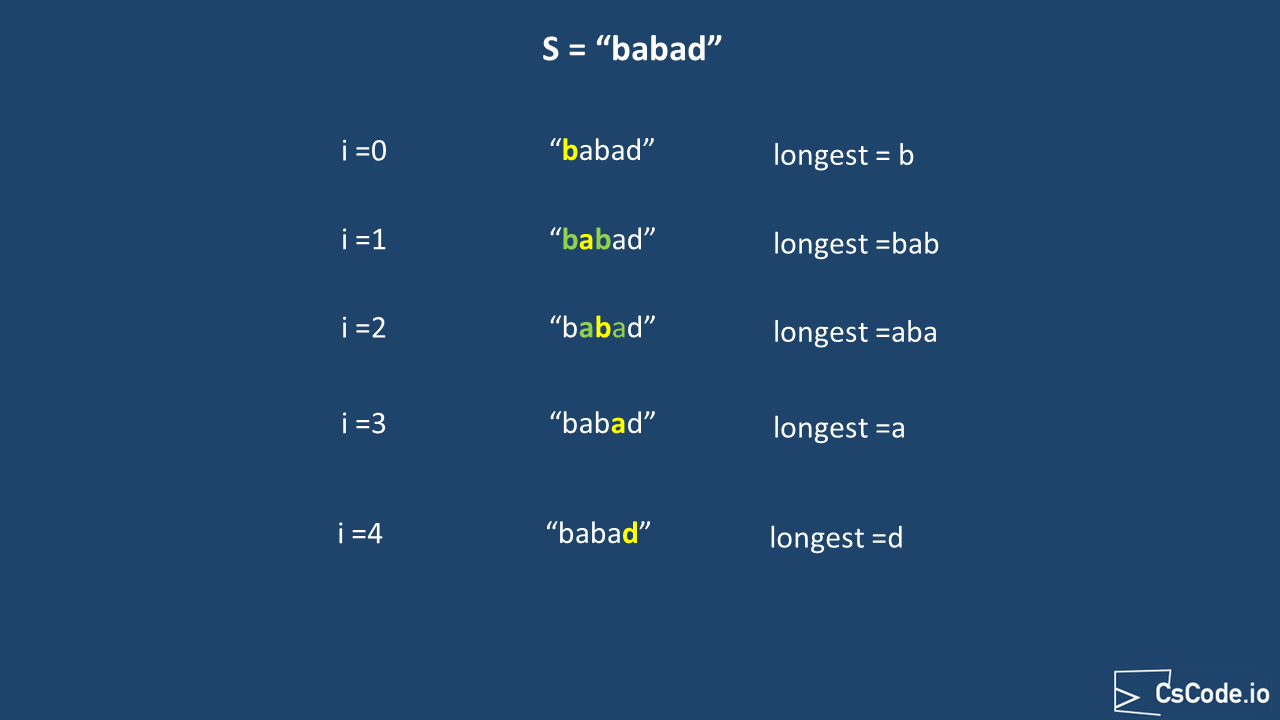
For example, when you expand around center for input string "babad", it will produce below output.
Below diagram only shows odd length palindromes, but the logic for even length palindromes is same,
expect you start with two characters from indexes ii+1
public class LongestPalindrome {

    /* expand around center*/
    static String expandAroundCenter(String s) {
        String maxPalindrome = "";
        for (int i = 0; i < s.length(); i++) {

            // this will check only odd length palindromes, because l and r pointing to same index i
            String maxPalindromeOdd = expandAroundCenterHelper(s, i, i);
            // since we have checked odd length palindromes above, we will repeat the same process for even length palindromes
            String maxPalindromeEven = expandAroundCenterHelper(s, i, i + 1);
            if (maxPalindromeOdd.length() > maxPalindrome.length()) {
                maxPalindrome = maxPalindromeOdd;
            }
            if (maxPalindromeEven.length() > maxPalindrome.length()) {
                maxPalindrome = maxPalindromeEven;
            }
        }
        return maxPalindrome;
    }

    static String expandAroundCenterHelper(String s, int l, int r) {
        String maxPalindrome = "";
        while (l >= 0 && r < s.length() && s.charAt(l) == s.charAt(r)) {
            if (r - l + 1 > maxPalindrome.length()) {
                maxPalindrome = s.substring(l, r + 1);
            }
            l--;
            r++;
        }
        return maxPalindrome;
    }

}
Complexity Analysis:
Time complexity: Above code runs in O(n2) time where n
Space complexity: O(n), since we have to keep track of maximum length palindrome substring.
Above implementations source code can be found at